
Why use problem-based collaborative learning?
Who said learning couldn’t be fun?
Research indicates that joy, play, humour and relationship-building all lead to better student outcomes and flourishing.
Rather than being a distraction, human connection is fundamental to thriving, which is why Escape Learning puts collaboration at the centre of its experiences.
During the Rogue Robot pilot study, teamwork and collaboration was frequently highlighted by students as their most-liked aspect of the whole experience.
Here are some of the features of our immersive escape room designs and how they benefit students:
-
While educational technology often focuses on the individual learner, our immersive escape rooms are designed to support problem-based collaborative learning — a pedagogical approach championed by many progressive schools and universities for its intrinsic motivation and promotion of higher-order cognitive retention, real-world transfer, autonomous thinking, and resilience in the face of ambiguity.
-
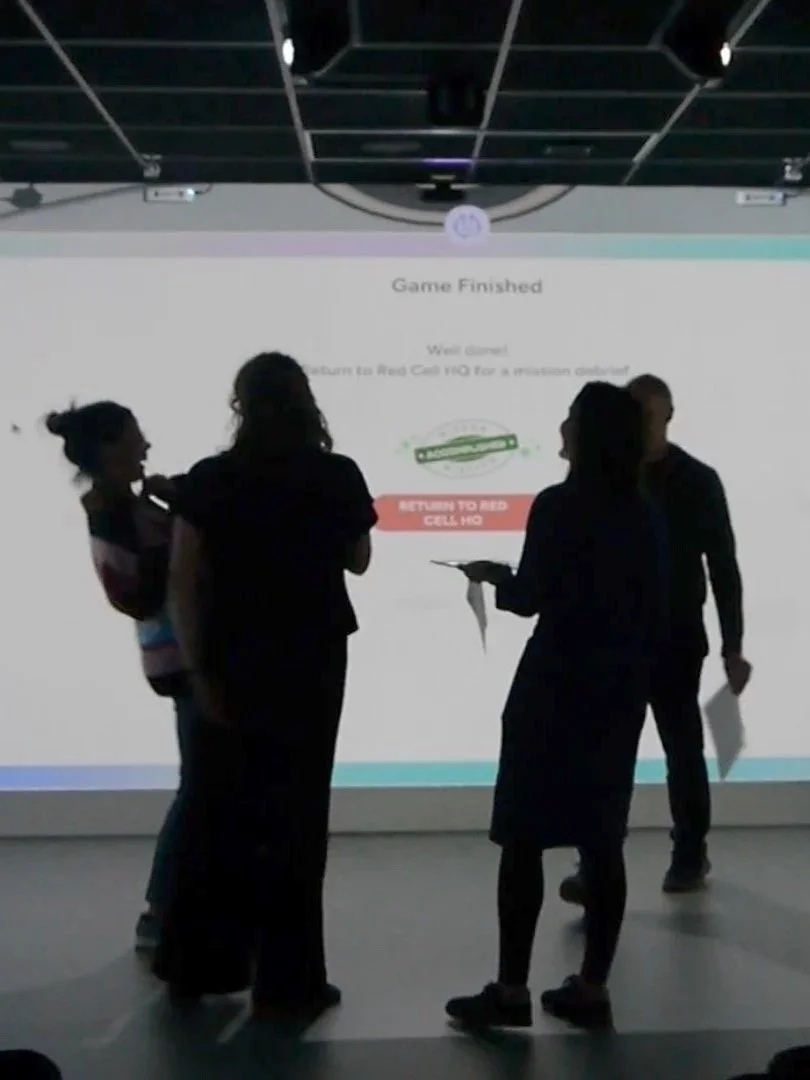
During the experience, students work in small teams, collecting clues and solving puzzles. But instead of being in a physical room, learners find themselves in a futuristic virtual space projected onto the walls of an immersive room.
Immersive rooms are ideal for collaborative learning scenarios because they do not inhibit natural human cues like eye contact and non-verbal facial communication in the way that Virtual Reality headsets do.
However, few existing immersive room programs offer the kind of non-linear, exploratory learning experience to be found in an Escape Learning scenario. -
The whole escape room experience is facilitated by an AI conversational agent, that helps build the narrative, scaffolds learning activities and offers feedback on the team’s performance.
These virtual coaches are carefully designed to mitigate issues like cognitive offloading, metacognitive disengagement, and reduced epistemic agency often associated with unguided use of generative AI.
This is achieved with five essential pedagogical principles that AI tutors often neglect (Vendrell & Johnston, 2026):
Preservation of cognitive friction to ensure effortful engagement and independent hypothesis formation
Scaffolded interventions with structured enquiries to encourage questioning outputs, rather than accepting AI as authority
Embedded evaluation as standard practice to cultivate epistemic vigilance
Fostering epistemic integrity by encouraging students to examine how their own perceptions influence reasoning
Reinforcement mechanisms that reward reasoning over remembering
meet the team

Ruth Hill, PhD
Founder and Director
Mathemagenic Ltd & Escape Learning
Ruth is an expert in the design of immersive, narrative-based learning experiences.
What began as frustration with the limitations of boring ‘click next’ e-learning led to a PhD study developing a pedagogical framework of the principal support mechanisms for successful problem-based learning experiences.
Over 20 years in the commercial ed tech sector, Ruth quickly gained a reputation for pushing the boundaries of what ed-tech can do and designing bold, entertaining and inspiring learning experiences that deliver measurable learning gains.
Gamification, interactive video and animation were core features of many of her early designs — not forgetting broader non-digital campaigns involving everything from pin badges to lifesize cardboard cutouts! In 2020, she turned her attention to virtual reality and AI, before founding Mathemagenic Ltd and Escape Learning.
trusted collaborators
Ruth is grateful for the assistance of a network of trusted, handpicked contractors without whom, Escape Learning could not achieve its goals.

Doug Allen
Founder of Bayou Software Ltd, Doug specialises in Unity and Godot software solutions for games, augmented reality, mobile apps and bespoke events and promotions.
Doug is passionate about projects that combine software and hardware in new and inventive ways to push the boundaries of traditional interaction.

Zillah Hayslip
Zillah is a talented illustrator and graphic designer who uses visual storytelling to turn complicated information into content people can understand, engage with and remember.
She has extensive experience with digital and interactive learning media, as well as specialist communications projects for presentations, whitepapers, exhibition graphics and illustrated products.

Mark Aberdour
A learning technology consultant with over 25 years of extensive experience implementing digital learning solutions and learning systems.
Mark specialises in simplifying the often overwhelming world of learn tech, empowering organisations to seamlessly adopt and deliver world-class learning experiences.

AnakIn Ryan
A senior 3D artist and CG lead with extensive experience of delivering production-ready assets, animation and real-time environments across Unreal Engine, Unity and traditional rendering workflows.
Anakin’s experience spans automotive, XR and simulation projects. He makes a pretty mean killer robot as well!

Nicola Slagter
A UX researcher and expert in the design and evaluation of digital experiences.
Nic facilitates and provides insights on our focus group sessions with students, subject matter experts and educators during design and user testing.

Shubham Maurya
A visual storyteller who works in film and VR.
Shubham crafts immersive virtual reality experiences and level designs for 3D games, paying meticulous attention to detail to create beautiful environments.
He also created Pythia’s brief to the Red Cell recruits in Rogue Robot.
are you ready for a new kind of learning experience?
Fill out the form to let us know what kind of educational immersive escape room experience you want for your students.